
The most common form of arthritis in men is gout – it affects well over 3 million men in the United States. In general, the advice given to men who have gout is that they should adopt a diet for gout by reducing their intake of purine rich foods such as seafood, meat, animal protein, and purine rich vegetables.
This recommendation was based on the assumption that reducing purine intake in all forms would inevitably have a beneficial effect on the occurrence of gout. This is because purines are metabolized in the body into uric acid, which is responsible for the formation of sodium urate crystals, and they in turn cause damage and inflammation to the joints.
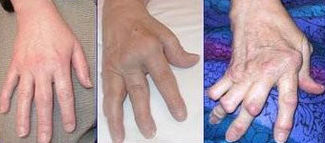
joints damaged by gout
However, interestingly enough in 2004 this article in the New England Journal of Medicine made the point that there were no studies which demonstrated the differing associations between the various factors in a gout diet – such as the balance of protein and purine in vegetables versus meat.
So this study was designed to work out how the different levels of consumption of purine rich foods (meat, seafood, vegetables and dairy foods), would affect the incidence of gout in a long term study of 47,000 men who did not report any history of gout at the start of the longitudinal study in 1986.
Dietary Purine Intake and Gout
This research investigated the dietary intake of men with a food questionnaire which sought to establish how often the men ate certain types of food – 130 foods and beverages in total.
The data collected was designed to establish the consumption by the men of these foods and beverages in the previous year.
A standardized table of protein and purine intake was established from published data about the nutritional content of the foods specified on the questionnaire. Every two years, the men self-reported whether or not they had gout, and updated their nutritional information.
Clearly this is an interesting experiment because it involves investigation of the predisposing factors in a normal diet towards gout in men over a long period of time, although it relies on some slightly shaky evidence – the self reporting of diet, the self reporting of food portion size, and even the self reporting of the occurrence of gout.
Even so it is certainly one of the best studies conducted so far around our understanding of the relationship between particular types of food consumption, foods to avoid with gout, and the risk of developing gout.
So for example the food intake among the men in the survey was divided into total meat, processed meat, seafood, purine rich vegetables, and dairy products – either low or high fat. Then the average daily intake of each group of these food substances was categorised into quintiles, which allowed a multivariate model to be derived – this basically means that the researchers could compare several variables against each other at the same time.
This 12 year experiment on 47,000 men documented 730 confirmed 730 new cases of gout, the incidence of which, incidentally, was highest between 55 years and 69 years of age.
Unsurprisingly, perhaps, increasing levels of meat intake were clearly associated with a higher risk of experiencing gout. And there was a direct relationship between the quantity of meat eaten and the probability of developing gout.
Similarly, the higher the level of seafood consumed by a man, the higher his risk of developing gout.
But this study was different to all the previous ones which had been conducted in that it demonstrated that the consumption of purine rich vegetables had no relationship to the risk of developing gout. And this was true for all levels of consumption.
It was a revolutionary finding at the time which changed the advice given to everyone with gout about the ideal diet for gout – previous advice had been to avoid purine rich vegetables. It now appeared that purine rich vegetables had little or no impact on the likelihood of a person experiencing gout – which is in direct contrast to the effect of eating meat and seafood. So the list of foods to avoid with a gout diet does not now include purine rich vegetables.
As far as dairy products were concerned, the same relationship was exactly the opposite as for seafood and meat – the higher the level of consumption of dairy products, the lower the risk of developing gout. But low-fat dairy products did not induce gout to the same degree. Again, this was a surprising finding and suggests that some nutritional element in high fat dairy products has a protective effect.
The fundamental question that had dogged researchers in the field of gout for decades was how protein and purine in the diet interacted to produce gout.
Now, for the first time, this study demonstrated very clearly that there were no risk factors associated with increasing protein intake.
Another surprising finding in this study was that there is no associated risk between body mass index and most dietary factors in the risk of gout – with the exception of seafood in a gout diet, where men with a higher body mass index seem to be less susceptible to gout than those with a low body mass index.
To sum it all up, what this research basically established is this: there is an increased risk of developing gout with increasing meat consumption and seafood consumption, but not with animal or vegetable protein, or purine rich vegetables.
And a particularly interesting finding is that the higher the level of consumption of dairy products, the lower the risk of gout.
Only in the context of a wider discussion about the nature of purines in food can some of these results be understood. At the time of the study, little was known about the exact nature of purines in different foods, and even less about the effect of cooking or processing.
However, one factor that might be responsible for the different levels of various risk factors in developing gout is the differing bioavailability of various purines in different foods.
If you have gout, or might be at risk, it’s worth trying to modify your diet for gout to reduce the risk of gouty arthritis. Keep in mind the following significant conclusions from scientific research – they will help you identify which foods to avoid with gout:
- Each additional daily serving of meat is associated with a 20% increase in the risk of gout.
- Each additional weekly serving of seafood is associated with a 7% increase in risk.
- The risk of gout caused by seafood consumption is higher among men who are NOT overweight than men who are overweight.
- There’s no association between the consumption of purine rich vegetables, either in combination or separately, and the occurrence of gout.
- And the higher total intake of animal or vegetable protein is not associated with an increased risk of gout either.
- Interestingly enough, protein from vegetable sources appears to have a slightly protective effect against development of gout, although the protective effect appears to be rather less than that protection provided by the consumption of protein derived from high-fat dairy products.
